who was walt disney ??
Welcome to my blog!!
Today’s highly recognizably protagonist was hailed as genius of entertainment, a wizard of animation, a pioneer of technology andtheme parks. The influence of Walt Disney on today’s popular culture and collective imagination cannot be understated. You can love him, hate him, or love to hatehim, but you cannot ignore his work. Walt Disney once famously said that that laughter is America’s greatest export.
It’s not. It’s travel and transportation, with $236Billion in sales in 2017. But sale of intellectual property, includingTV and movies, amount to $49 Billion, which is twice the GDP of Cyprus. So, if by laughter we mean entertainment,then yes – American entertainment is one of the country’s most important exports,and these days, a good chunk of that intellectual property is owned by Walt Disney Studios:Pixar, Buenavista, and Miramax, plus the Marvel and the Star Wars franchises, are some ofthe largest and most visible entertainment companies owned by the House of Mouse. Disney’s legacy can capture the imaginationof every girl or boy from early childhood all the way through adulthood. And to think -- it all started with the doodleof a mouse, sketched during a depressing train ride home.
But we’re getting ahead of ourselves... Toilet Paper and Start UpsWalter Elias Disney, later known as Uncle Walt, was born on December 5, 1901, in Chicago,Illinois. His parents, Flora and Elias, were farmersand occasional entrepreneurs of Canadian origin. Walt was the youngest of five siblings, theothers being Ruth, Roy, Raymond and Herbert. His much older brothers would prove a sourceof stability and inspiration later in life. At the age of seven, Walt and the Disneysmoved to Kansas City, where he spent most of his childhood.
This was an unhappy period of his life. Elias Sr had a hard time making a living,switching from farming to distributing newspapers. In each of these activities, Walt and hissiblings were drafted to work hard and contribute to the family’s welfare. Elias was a tough taskmaster and did not approveof Walt trying to carve out time to do homework or even attend school. You can probably imagine how Elias took tohis son’s budding talent for drawing – he considered it a complete waste of time andwould not spend a cent on something as futile as art supplies.
Walt was reduced to drawing his first sketcheson toilet paper. Walt’s harsh relationship with his fatherwas mitigated by Walt’s close relationship with his big brothers, especially Roy andHerbert, who were an early source of encouragement. Unfortunately, Roy, Raymond and Herbert movedout of the family home eventually, leaving behind the much younger Walt. In 1917, the US joined the Entente in WWI. Alongside many other patriotic American boys,Walt longed to do his part by donning a uniform to serve in France. He may have also had the added motivationto leave his home behind. Considering the fact that he faked his ageto join the army at 16, Walt was likely trying to escape from his home life.
Unfortunately, he was rejected for being tooshort. Walt had a Plan B: he successfully appliedto join the American Red Cross. While training as an ambulance driver, Waltdeveloped his artistic skills, and he became quite popular for decorating the ambulanceswith cartoons and caricatures of fellow paramedics. One of his fellow trainees was one Ray Kroc– the legendary CEO of McDonald’s. Walt’s appetite for action remained unfulfilled;the war was over before he was even deployed overseas. But when he returned home, he had a good reasonto rejoice -- he found out he had won a scholarship to attend the Kansas City Art Institute.
After years of having to draw on toilet paperand ambulances, the poor guy deserved a break. And proper art supplies! While attending the Art Institute, Walt developeda fascination for the growing genre of animation. Animated shorts were commonly used at thetime in movie theatres as a crowd pleaser before the main feature. But they were crudely made, the soundtrackwas irrelevant and some of them were just creepy as hell.
Walt saw an opportunity to fill a potentialgap in the market with products of good quality. With a friend from the Art Institute, Ub Iwerks,Walt set up his first animation company. It was a bold move, considering that the twowere nineteen and had little to no capital to start with. Walt and Ub developed a series of short animatedmovies for the Newman chain of cinemas entitled "Newman's Laugh-O-Grams". The company was short lived, running from1920 to 1923, but its cartoons were a hit with audiences.
Walt experimented with some of the themesthat would become a staple of his later production: anthropomorphised animals, innovative takeson classic fairy tales, a keen ear for popular music – jazz at that time - and slapstickhumour. Though Walt and Ub were talented animators,as businessmen, they were, well … they were pretty rubbish. The production costs of their shorts weretoo high, and they signed unfair distribution deals. They thought they had hit jackpot when a distributorcompany called Pictorial Clubs of Tennessee promised $11,100 for six cartoons - $142,000in today’s money. But Pictorial never paid, and the Laugh-o-gramcompany soon went bankrupt. Interest asiding here: if today, some Laugh-o-gramsare still in tact and available, it’s thanks to those Pictorial Clubs scoundrels – theykept the six cartoons in their vault and reissued them when Disney had become a household name. The fellow animator, and other employees ofWalt’s start-up, were about to call it quits.
But Walt had a brilliant idea, with greatpotential: how about mixing live action with animation? Walt’s pitch was to film a series of shortsstarring child actress Virginia Davis with an innovative technique: mixing a live actionprotagonist with animated characters and settings. Walt and Ub moved to California to start workon this new series, entitled the "Alice Comedies". Their early work attracted the attention ofa New York based distributor, Margaret J. Winkler. Disney’s work was again plagued by highproduction costs, which made the first Alice Comedies unprofitable.
On Winkler’s insistence, Walt and Ub wereforced to increase their rate of production, while lowering the animators’ salaries. By this time big brother Roy Disney had joinedthe company and he seemed to have a much better business sense than Walt. He would remain his business partner and trustedadvisor for the rest of his life. It was perhaps on Roy’s advice that Waltand Ub decided to hire an entirely female crew of colourists. Traditional animation requires for each frameof a cartoon to be coloured by hand. That’s 24 frames per second of footage. So, it’s a meticulous, repetitive, timeconsuming job requiring large numbers of skilled professionals. At that time, women’s wages were much lowerthan men, which meant big savings for the Disney brothers. One of the colourists was a young woman fromIdaho called Lillian.
At the end of a long day’s work, Walt wouldroutinely drive home a group of his employees. Whatever the route, he would always make surethat the last person to be dropped off was Lillian, so that he could spend more timealone with her. Lillian probably got the hint, and the twostarted dating. This led to a short engagement, and, eventually,their wedding, in July of 1925. By 1927, American audiences had grown wearyof the Alice Comedies shorts, and Walt wanted to diversify his production. He started working on a new character, Oswaldthe Lucky Rabbit. This series was successful, and Walt consideredrescinding his contract with Margaret Winkler to chance distribution on his own. But in 1928, Walt discovered that Margaretand her husband, Charles Mintz, later of Universal Pictures, were masters of the fine print atthe bottom of contracts.
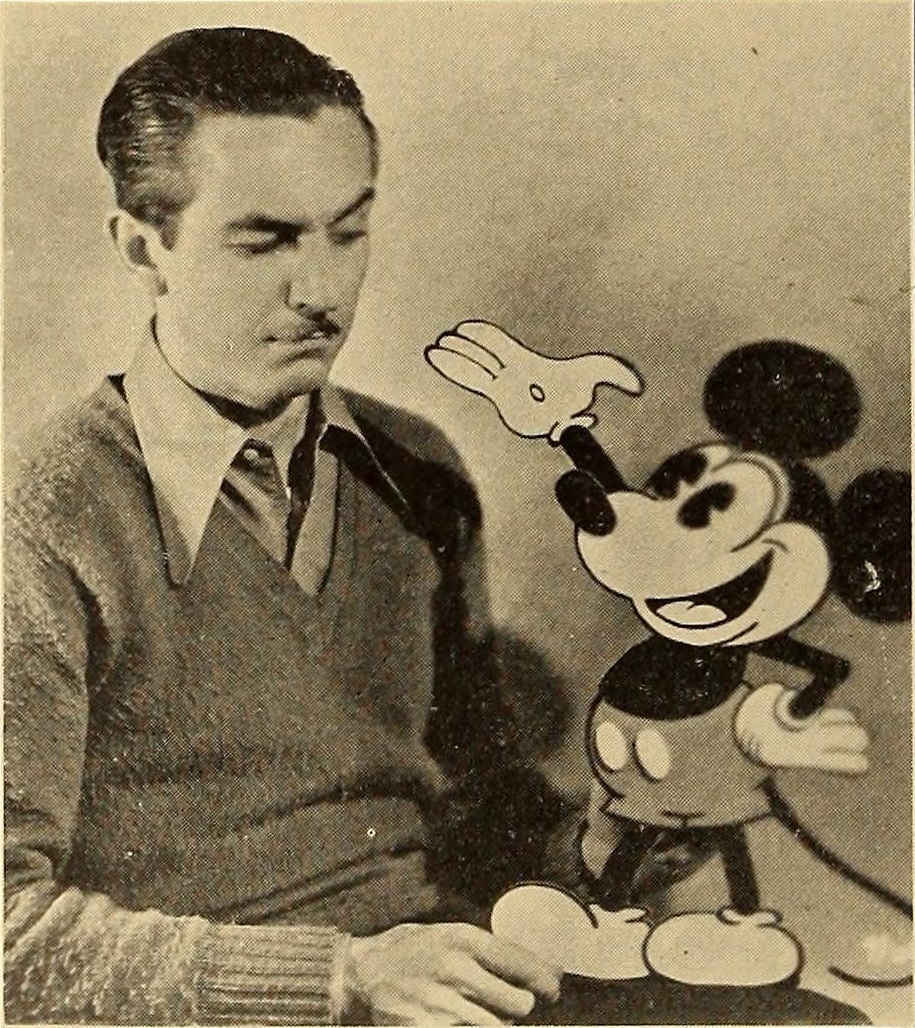
During a business meeting in New York, helearned that, as part of his deal with Winkler, every intellectual property developed withinthe terms of the contract would be legally owned by Winkler and Mintz. Unbeknownst to him, the New York power couplehad another nasty trick in reserve. Their pushy demands and deadlines for theAlice films alienated Disney’s animators. Most of them had vented their frustrationagainst Walt – rather than Winkler. So, when they eventually quit the company,they were hired en masse by Universal! Only Iwerks would remain by Walt’s side. While riding the train back to Californiafrom New York, a depressed Walt Disney put pencil to paper to soothe his sadness andfrustration. Little did he know, that doodle would changehis life, and have a huge impact on the lives of millions of children. The character he sketched that day was theimmortal Mortimer Mouse. House of Mouse‘Mortimer who?’ you may ask. Well, that character was Mickey Mouse, butWalt’s initial choice of name was Mortimer.
Luckily Lillian talked him to his senses andadvised he change the name to Mickey. If you are into this sort of thing, the name“Mortimer” is of old French origin and means ‘Dead Sea’ – not the cheeriestof names for a talking mouse! Walt’s company was now called Walt DisneyCartoons. A skeleton crew which included only him andUb on drawing and animation duties, with Roy supervising the business, and his wife andEdna colouring and inking with Lillian. The gang soon delivered three Mickey Mousecartoons.
The first two did not sell. For the third one, Walt had the intuitionto add a recent cinematic innovation: a synchronized soundtrack, which included a catchy whistlingtune. This third cartoon was ‘Steamboat Willie.’ It opened on November 18, 1928 and it wasan immediate success for Walt Disney Cartoons. Finally the big break had arrived and thecompany would produce a string of hit animated shorts. In 1929, they created the cartoon series 'SillySymphonies'. A 1932 episode, Flowers and Trees, was thefirst cartoon to be produced in colour and to win an Oscar. The follow up, the Three Little Pigs of 1933,was so popular that it got top billing above the feature films it accompanied. While working on the Silly Symphonies, Waltand Lillian were trying to conceive a child.
Unfortunately Lillian suffered several miscarriageswhich caused Walt to experience a nervous breakdown. Eventually, a baby girl named Diane arrivedin 1933. The Disneys decided to adopt another girl,Sharon, in 1936. The successes of his cartoons and a growingfamily emboldened Walt, who now started to think big: why should cartoons be developedonly in short format? Why not produce a full-length feature animatedfilm?
Your wish will soon come trueIn 1934, Walt started working on that idea: a cartoon that ran the length of a featurefilm. As he had done previously, Walt sought inspirationfrom a classic Fairy Tale: Snow White by the Brothers Grimm. Nobody in Hollywood believed in Walt. Among the studio lots, film executives sneeredat the project, calling it "Disney's Folly". The production was not easy, going over timeand over budget. But when Snow White and the Seven Dwarfs openedon the December 21, 1937 it won immediately the hearts and minds of both audiences andcritics. Including subsequent releases, and adjustingfor inflation, Snow White is the tenth highest grossing movie of all times.
At the 1938 Academy Awards, the film was nominatedfor best soundtrack and received a Special Award for ‘significant screen innovation’– in the shape of one normal-sized Oscar and seven little statuettes. Walt Disney Studios continued working on shorts,but the main production focus was firmly on feature-length cartoons. Walt’s next two projects were incrediblyambitious: he released Pinocchio and Fantasia, both in 1940. Pinocchio was a relative success – not asastounding as Snow White - but Fantasia tanked. If you haven’t seen it yet, press pause,go and find a DVD, a VHS, a Betamax, whatever, and watch it now.
Welcome back. Seen it? Did you like it? I told you it was awesome! But 1940 audiences did not agree with ourmodern sensibilities, and for the next production, Dumbo, Walt had to tighten the belt and reducecosts to a minimum. Dumbo’s artwork and animation are visiblycruder than the three previous movies, and the runtime is also quite short – but thefilm was highly profitable.
This relative reduction in quality may havealso been a consequence of a studio animators’ strike, an event which deeply angered andworried Disney. Boss DisneyA 2006 biography of Walt Disney by Neal Gabler sheds some light on Walt’s relationshipwith his employees, trade unions, and communism. To put it simply, Walt Disney was a toughboss to work for: it is no surprise that his employees wanted to organise themselves ina union, but he considered industrial action as a dangerous expression of communist tendencies. Think of this example.
When Walt turned 35, his brother Roy encouragedemployees to throw the boss a surprise birthday party. Two of the animators thought it would be afun idea to create a short cartoon of Mickey and Minnie Mouse … going at it. (Wink wink, nudge nudge.) When Walt saw the animation at the party,he laughed hard and asked who had made the film. The two animators stepped up, expecting apat on the back or a handshake.
He fired them on the spot. In general, Walt could be controlling andasked a lot from his employees, resorting to humiliating dress-downs if they did notdeliver. Even Roy was not spared. The business brain behind Walt Disney studioswas frequently scolded when he offered an opinion on artistic choices. Uncle Walt’s employees, animators, and cartoonistswere the ones subject to longest hours and gruelling work conditions. Taking a break was a luxury, as Walt wouldoften appear suddenly in the drawing rooms to check on their work.
Luckily for the employees, Walt was a heavysmoker: with time he had developed a persistent cough that announced his arrival by a fewseconds! When his cartoonists tried to form a union,Walt reacted by hiring armed guards, firing organisers and cutting wages. Well, the 1941 strike … but he really askedfor it! On the July 2, 1941 Disney published an advertin Variety, accusing the strike leaders of ‘Communistic agitation’. This concern about Communist infiltrationsin Hollywood led him to join the Motion Picture Alliance for the Preservation of AmericanIdeals, or MPA. Founded in February 1944, the MPA was an organisationcomposed of high-profile showbiz personalities with the purpose of defending Hollywood – andAmerica as a whole – against Communism and Fascism. The MPA was active until 1975 and notablemembers included John Wayne, Ronald Reagan and Ginger Rogers to name a few.
The MPA volunteered to testify in front ofthe House Committee on Un-American Activities. The Committee was created in 1938 to investigatealleged disloyalty and subversive activities on the part of private citizens, public employees,and organizations suspected of having Communist ties. Walt also participated in the hearings ofthe committee, accusing several leaders of the animators’ strike of being Communistagitators. His testimony earned him the gratitude andfriendship of legendary FBI Director J. Edgar Hoover – one whose life we’ll tell sooneror later. Hoover and Disney developed a strange artisticpartnership.
In the following years, J. Edgar allowed WaltDisney Studios to film some of their live action movies at the FBI headquarters in Washington. Walt, on the other hand, agreed to submitsome of his scripts to Hoover for an early revision, to ensure that the FBI was depictedcorrectly, but apparently, Hoover did not make any changes to the classic animated films. This is an odd refrain he would have slashedhalf of Peter Pan’s script for depicting an anarchist commune and abuse of substancesthat literally get you flying.
In addition to these exchanges of favours,Hoover had Disney appointed as ‘Special Agent in Charge Contact’ in 1954. In other words: a trusted informer and collaboratorof the FBI. Fun fact – decades after Walt Disney’sdeath, his company would pay homage to the FBI chief with a minor character: J. GanderHooter from TV series Darkwing Duck. In the 1950s Walt Disney eventually distancedhimself from the MPA, as he lost interest in their ideals and their paranoid approachto anti-Communism. Walt’s association with the MPA is the sourceof the rumour that he was anti-Semitic, but biographer Neal Gabler, otherwise a harshcritic of Disney’s, dismisses this claim as unsubstantiated. Walt regularly hired, or had business with,Jewish employees and colleagues. In 1955 he was even appointed ‘man of theyear’ by the B’nai B’rith International, a Jewish cultural organisation.
This is not the only persistent, unfoundedrumour on Walt, more on this later. A Triumph of the ImaginationIn the 1950s and 1960s Walt Disney studios produced a series of animated masterpiecesthat won well-deserved popular success. I’ll list them all, because I know if Imiss one, I’ll get backlash in the comments: Cinderella (1950), Alice in Wonderland (1951),Peter Pan (1953), Lady and the Tramp (1955), Sleeping Beauty (1959), 101 Dalmatians (1961)and Mary Poppins (1964). Everybody has a favourite of course, but whatabout your least favourite?
Write your vote in the comments and tell uswhy you chose it! My personal favourite? Why! ‘tis Mary Poppins of course! Not only Dick Van Dyke’s spot on cockneyaccent reminds me of my relatives in London … but it’s Disney’s first superheromovie if you think about it – long before the Marvel acquisition came along. Mary has the powers of Flight TelekinesisInterdimensional travel Mind manipulation through the medium of songInfinite storage capabilities So, yeah, studio executives, when you areplanning the next Avengers film, how about you draft in Poppins, too? Mary Poppins successfully merged live actionand animation in colour. Before that, Disney studios had ventured intopurely live action films, the first one being Treasure Island in 1950. Disney was also one of the first Hollywoodproducers to invest in TV. The first of his series on the small screenwas
The Magical World of Disney – which actually can be considered an early exampleof Content Marketing to promote a good or service. What was Disney promoting? His next big dream, the one that would takemost of his energy and attention for the last decade of his life, was a massive, innovativetheme park in Southern California: Disneyland. The park was developed in the town of Anaheim,after demographics experts convinced Walt that it would become a major population centrewithin 10 years.
Tme would prove they were right, when localpopulation, and park visitors, soared. Disneyland opened on the July 17, 1955 andits first day was a disaster. 30,000 people turned up instead of the projected15,000, meaning restaurants were soon out of food and drink. A plumber’s strike forced Walt to choose:either have flushing toilets or working drinking fountains. He chose the toilets. One of the attractions was so overgrown withweeds that Disney ordered to place around placards with Latin names.
To disguise the shrubbery as an arboretum,in other words! Of course, everything improved, and Disneylandbecame one of the most, if not the most visited and successful theme parks Worldwide. When looking at visitors’ stats, Disneyrealised that only a small fraction came from the West Coast. That’s when he got the idea of buildinga sister park in Florida, Disney World, developed around the prototype of a futuristic perfectcity, called EPCOT. But Walt Disney would not live to see hisnew dream come true. For most of his adult life he had been smokingthree packs of unfiltered cigarettes, every day. His daughter Diane tried, and failed, to convincehim to cut back. They reached a compromise: he would at leastsmoke three packs of filtered cigarettes – but he just removed the filters behind Diane’sback! Inevitably in 1966, Walt Disney was diagnosedwith lung cancer.
He underwent surgery, but due to post-operativecomplications, Walt had a heart attack and died on December 15, 1966 at age 65. Contrary to popular and persistent rumours,his body was NOT cryogenically preserved and/or hidden in a vault under Disneyland. Walt was simply cremated, and his ashes wereinterred at Forest Lawn Cemetery in Los Angeles, California. LegacyI hope you forgive me for stating the obvious, but Walt Disney was, and still is, a controversialfigure, as is normal for somebody whose influence on the surrounding world and society is largerthan life. A personality like Disney will never be freefrom exaggerations, slander and rumours – or, the opposite risk, is to portray him exclusivelyin a saintly light.
For sure, Walt Disney was certainly not thefairest of business leaders, not the most balanced of workplace bosses, not the mostlevel-headed when confronted with different political ideas. But it is also true that he did deliver alasting impact on society, culture and children through his innovative work. As Walt once said:“I'd rather entertain and hope that people learn, than teach and hope that people areentertained”
thanks for reading
0 Comments